

1. Why this comparison keeps coming up
Wrong cache decisions show up fast. A cache that cannot return results quickly enough routes traffic to the primary database, adding latency and cost at the same time. Over-provision memory and you pay for capacity that mostly sits idle.
Redis and DynamoDB appear in the same conversation because teams on AWS often already run both. Redis handles application-layer caching in many stacks, while DynamoDB serves as the primary database for serverless and event-driven architectures. Whether you actually need both services, or whether DynamoDB can satisfy the caching requirement on its own, is a decision worth working through before provisioning anything.
The comparison is harder than it looks. DynamoDB is not a cache. It is a persistent NoSQL database with a TTL feature that lets items expire on schedule. Using it as a cache is a legitimate pattern, but the two tools serve different purposes, and treating them as direct substitutes produces poor architecture decisions.
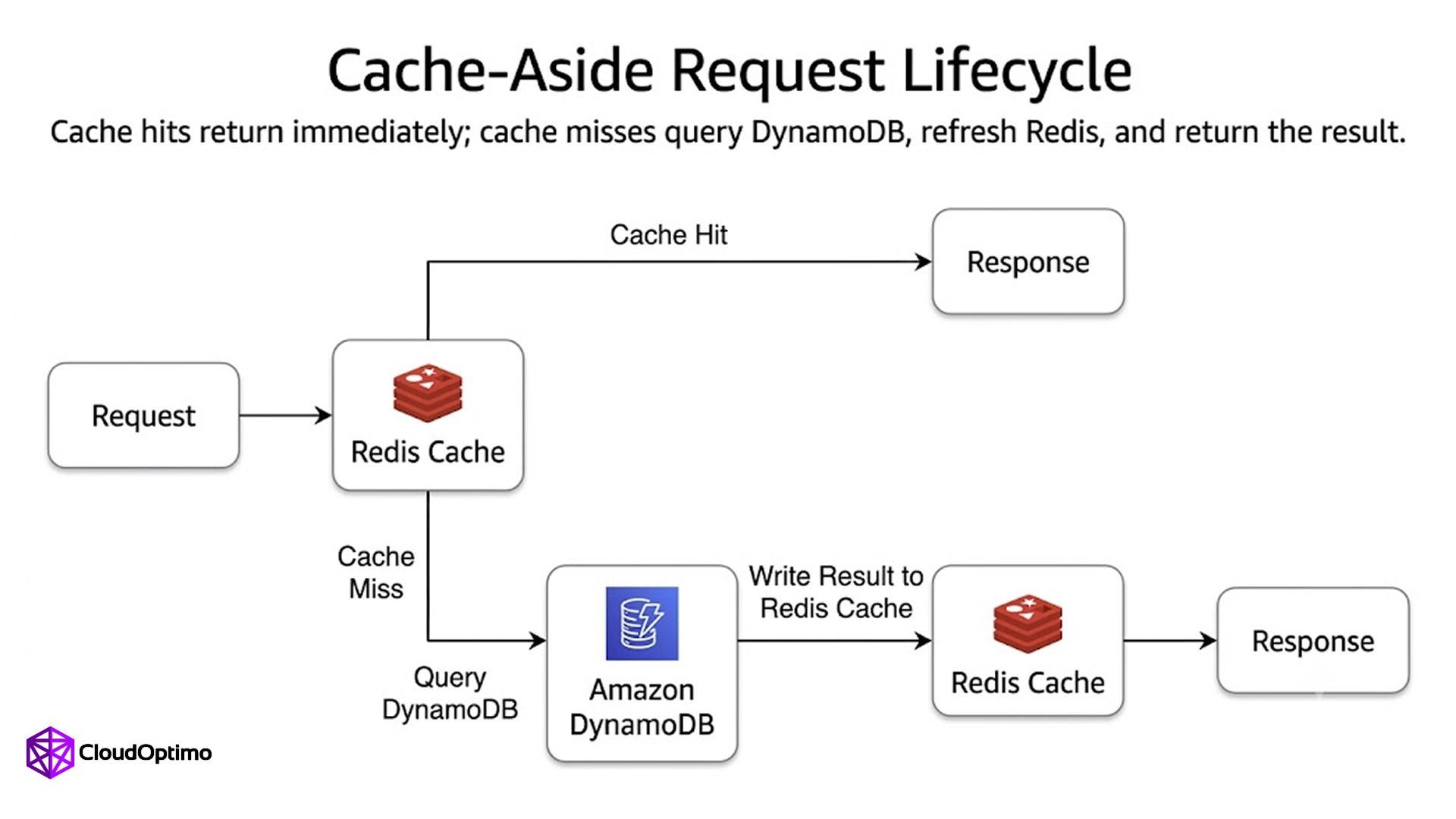
Figure: Cache-aside request flow: Redis serves cache hits, while misses query DynamoDB and refresh the cache before returning a response.
2. What Redis and DynamoDB actually are
Redis is an in-memory data store. It keeps its working dataset in RAM, which is why reads return in under a millisecond under normal load. Teams reach for Redis for caching, session storage, rate limiting, leaderboards, and message brokering. Its native data structures, including sorted sets, hashes, lists, and streams, give it flexibility well beyond simple key-value caching.
DynamoDB is a fully managed, persistent NoSQL database. Data is written to SSDs across multiple availability zones on every operation, giving it durability that Redis cannot match without extra configuration. Its TTL feature marks items for automatic deletion after a timestamp you set. That behavior resembles caching, but DynamoDB is not designed around memory eviction patterns.
The piece that changes the comparison is DAX (DynamoDB Accelerator), a fully managed in-memory cache that sits in front of DynamoDB tables. DAX reduces read latency from single-digit milliseconds to microseconds, putting DynamoDB with DAX in the same performance range as Redis for cached reads.
Any useful comparison between these two for caching has to specify which DynamoDB configuration is actually on the table.
<!-- IMAGE: Two-panel architecture diagram. Left panel: Redis as a cache layer between the application and a primary database. Right panel: serverless stack showing API Gateway, Lambda, DAX, and DynamoDB in sequence. -->
3. Head-to-head: key differences that actually matter for caching
Latency
Redis returns cached reads in under a millisecond for typical payloads. DynamoDB standalone delivers single-digit millisecond reads, fast enough for many applications but behind Redis for latency-sensitive workloads. DynamoDB with DAX closes that gap: DAX serves cache hits from memory at microsecond latency, which puts it in the same range as Redis.
The practical implication: if you need sub-millisecond reads and you are not already running DynamoDB, Redis is the simpler path. If you are already on DynamoDB and need faster reads, add DAX before introducing a separate Redis cluster.
Data model
Redis supports strings, hashes, sorted sets, lists, sets, streams, and geospatial indexes natively. Sorted set range queries, hash field increments, and list operations all execute server-side without fetching the full object.
DynamoDB supports key-value and document models. For pure key-value caching, the gap is minimal. Use cases that rely on server-side operations against complex data structures are where Redis pulls ahead, since DynamoDB has no equivalent of sorted set range queries or server-side hash operations.
TTL and eviction
Redis supports per-key TTL alongside configurable eviction policies: allkeys-lru, volatile-lru, allkeys-lfu, and others. When memory fills, Redis applies the eviction policy automatically and continuously.
DynamoDB's TTL marks items for deletion after a timestamp. AWS states that expired items can persist for up to 48 hours after their TTL attribute expires. There is no eviction policy because DynamoDB does not operate under memory constraints in the same way.
Persistence
Redis saves RDB snapshots to disk by default on a configurable schedule. AOF (append-only file) logging is available for stronger durability, recording every write. Either way, a crash between save intervals or sync windows can result in data loss.
DynamoDB writes to multiple availability zones on every operation. No extra configuration is required. For use cases where cache entries cannot be lost, DynamoDB's durability model is the more reliable choice.
Cost
Redis on ElastiCache is priced by node type. You pay for provisioned memory regardless of actual utilization. Larger working datasets require larger, more expensive node tiers.
DynamoDB charges per read and write request unit plus storage. For bursty, unpredictable traffic, that model can be cheaper than a Redis cluster that sits mostly idle. Adding DAX reintroduces node-based pricing on top of DynamoDB costs, which can flip that calculation for read-heavy workloads.
| Factor | Redis | DynamoDB standalone | DynamoDB + DAX |
| Read latency | Sub-millisecond | Single-digit ms | Microseconds |
| Data structures | Strings, hashes, sorted sets, lists, streams, and more | Key-value, document | Key-value, document |
| Eviction | Configurable (LRU, LFU, and variants) | Not supported | Not supported |
| TTL | Per-key, applied immediately | Per-item, up to 48-hr lag possible | Per-item, up to 48-hr lag possible |
| Persistence | RDB by default; AOF optional | Multi-AZ on every write | Multi-AZ on every write |
| Cost model | Memory-based (node size) | Request units + storage | Request units + storage + DAX nodes |
4. When Redis Is the Right Cache
Redis excels in scenarios where in-memory speed is a hard requirement and the data structures involved go beyond simple key-value lookups.
Session and authentication token storage is one of Redis's strongest fits. Tokens expire naturally through TTLs, and sub-millisecond read latency means authentication overhead stays invisible to end users. Redis handles this without a dedicated schema or secondary index.
Rate limiting and counters benefit from Redis's atomic increment operations. A counter can be incremented and checked in a single round trip, which is essential for enforcing limits accurately under concurrent load. Alternatives that rely on conditional writes or transactions introduce latency and complexity at this step.
Real-time leaderboards are a textbook Redis use case. Sorted sets allow scores to be updated and ranked queries to be served in O(log N) time, without reindexing or query-planning overhead. This is difficult to replicate cleanly in a relational or document store at production scale.
API response and page caching work well when the cached value is a serialized object or rendered output. Redis's support for string, hash, and list types means cached responses can be stored directly without transformation.
Where Redis falls short:
- Memory is the storage medium, so cost scales proportionally with data volume. Large datasets that do not match a hot-data access pattern become expensive to hold in memory.
- Redis persistence (RDB snapshots and AOF logs) offers weaker durability guarantees than DynamoDB's multi-AZ replication. For caches where loss is acceptable on failure, this is usually not a concern. For caches acting as a source of truth, it warrants careful consideration.
- Running Redis means maintaining a separate service: nodes, memory sizing, failover configuration, and monitoring. That operational surface is real and recurring.
A note for AWS teams: ElastiCache now defaults to Valkey for new clusters. Valkey is a BSD-licensed open-source fork of Redis 7.2.4 maintained by the Linux Foundation. The API is fully compatible with Redis, so the evaluation in this post applies equally to both.
5. When DynamoDB Makes Sense for Caching
DynamoDB is not designed as a cache, but it is a practical caching layer in specific circumstances where its properties align with what the application actually needs.
Minimizing additional services is a legitimate engineering priority. If your application already depends on DynamoDB for primary data storage, adding a Redis cluster introduces a second operational dependency: separate scaling decisions, additional connection management, and one more failure point to monitor. For teams where operational simplicity is a real constraint, keeping the caching layer on DynamoDB avoids that overhead.
Durability requirements change the tradeoff significantly. A conventional cache is considered ephemeral; data loss on restart is expected and the system falls back to the origin. DynamoDB's multi-AZ replication means cached values survive process restarts, node failures, and availability zone events. If the items being cached are expensive to recompute and an empty cache causes meaningful impact on users, DynamoDB's persistence profile is an advantage rather than overhead.
Serverless and bursty workloads are a natural fit. DynamoDB's on-demand capacity mode scales from zero and charges per request, which means no idle memory nodes consuming cost during off-peak hours. For workloads that spike unpredictably and then go quiet, this model is often more economical than maintaining always-on Redis nodes.
DynamoDB Accelerator (DAX) addresses the latency gap directly. DAX is a fully managed, DynamoDB-native in-memory cache that delivers microsecond response times on read-heavy workloads without requiring application changes beyond the client library. For teams already invested in DynamoDB who need lower latency, DAX is the intended path before introducing an additional caching system.
Where DynamoDB loses:
- Mixed data structure support is limited compared to Redis. Sorted sets, bitmaps, and pub/sub have no native equivalent in DynamoDB.
- DAX adds its own operational surface: cluster sizing, subnet group configuration, and IAM policy management.
- Without DAX, DynamoDB's single-digit millisecond latency is not competitive for sub-millisecond requirements.
6. How to Decide: A Practical Framework
The Redis versus DynamoDB caching decision is not primarily a performance comparison. It is an infrastructure tradeoff shaped by latency requirements, data lifecycle needs, and the operational constraints of the team maintaining the system.
The criteria below provide a starting point for most teams.
Latency requirement under 1 ms, no DAX in your stack Choose Redis. DynamoDB without DAX cannot reliably deliver sub-millisecond response times. Redis was built for this range and consistently meets it under normal load conditions.
Already on DynamoDB, latency requirement in the microsecond range Add DAX before adding Redis. DAX is purpose-built for this scenario. Introducing Redis alongside DynamoDB when DAX is available creates redundant complexity without a clear benefit.
Serverless-first AWS architecture DynamoDB with DAX is the cohesive choice. Both services scale on demand and integrate natively with Lambda and API Gateway, keeping the architecture consistent without always-on infrastructure.
Session caching or rate limiting Redis is the more appropriate tool. TTL-based expiry, atomic counters, and the EXPIRE command are first-class features in Redis. Replicating them in DynamoDB requires additional design work and conditional write logic.
Cache entries must survive restarts or node failures DynamoDB is the better fit. Treat this as persistent caching rather than conventional ephemeral caching, and size the table accordingly.
Minimizing operational surface area is the priority DynamoDB with DAX keeps the stack consolidated. A single data service with a native caching layer is easier to operate, audit, and hand off than two independent systems running in parallel.
On hybrid architectures: Some production systems run Redis and DynamoDB together, using Redis for hot session and rate-limiting data and DynamoDB for durable state. This is a valid pattern, but it should be a deliberate choice rather than a default. The added complexity is justified only when access patterns genuinely differ enough to require both services.
The decision tree below captures these branches visually, starting from the question "What does your cache need to do?" and branching on latency, persistence, and infrastructure.
Conclusion
Redis and DynamoDB are both capable caching layers. The question is not which one is better in isolation, but which one fits the specific requirements of the system being built.
Redis is the right default when latency is the primary constraint and the team is prepared to manage a dedicated in-memory service. Its data structures, atomic operations, and TTL support make it well-suited for session management, rate limiting, and real-time ranking without significant design overhead.
DynamoDB becomes the more practical choice when the team is already operating within the AWS ecosystem, when cache durability matters, or when the workload is serverless and bursty enough to make always-on memory nodes cost-inefficient. DAX closes the latency gap for teams who need microsecond response times without leaving the DynamoDB model.
For most teams, the framework in Section 6 will narrow the options to one path quickly. Where it does not, the answer is usually to start with the simpler option for the current scale and revisit once actual performance data justifies the additional operational investment. Premature optimization toward a hybrid architecture adds complexity that most systems do not need early on.
AWS teams using ElastiCache should note that new clusters now default to Valkey. The evaluation in this post applies equally to Valkey, which maintains full API compatibility with Redis 7.2.4 under BSD licensing.

