
1. Introduction
Artificial intelligence applications are evolving from single-model implementations to distributed systems that use multiple specialized models for different tasks. While this improves flexibility and response quality, it also introduces new infrastructure challenges. Applications must determine which model to use, manage requests across multiple providers, and maintain consistent performance across cloud environments.
An AI Gateway addresses these challenges by acting as a centralized control layer between applications and AI models. It manages authentication, intelligent routing, governance, and observability through a single interface, enabling organizations to build scalable, secure, and cloud-native multi-model AI applications without tightly coupling software to individual model providers.
2. Understanding AI Gateways
An AI Gateway is an infrastructure layer that manages communication between client applications and one or more AI models. Similar to how an API Gateway manages REST or GraphQL services, an AI Gateway standardizes how AI requests are authenticated, routed, monitored, and governed before they reach a model endpoint.
Without an AI Gateway, applications often require separate integrations with each AI provider, increasing authentication, monitoring, and maintenance complexity.
An AI Gateway solves this by providing a single entry point for AI traffic. Applications communicate with the gateway instead of directly interacting with multiple AI services. The gateway validates requests, applies organizational policies, selects the most appropriate model, and returns the response through a consistent interface.
Unlike traditional API Gateways that primarily focus on request forwarding, AI Gateways understand AI-specific requirements. They can make routing decisions based on prompt characteristics, model capabilities, latency objectives, token limits, or business policies. This additional intelligence allows organizations to manage multiple AI services without exposing application developers to provider-specific implementations.
3. Why Multi-Model Cloud Applications Need AI Gateways
Modern AI applications rarely depend on a single model. Different workloads often require different capabilities. One model may provide advanced reasoning, another may specialize in code generation, while another offers lower inference costs for routine tasks. Managing these models independently increases operational complexity and creates inconsistent application behavior.
An AI Gateway provides a centralized control layer for these interactions. Instead of embedding provider-specific logic within every application, routing decisions, authentication, policy enforcement, and request management are handled in one place. This allows applications to remain focused on business functionality while the gateway manages AI infrastructure.
For organizations evaluating cloud AI platforms, our 2025 analysis of Google Vertex AI, Amazon Bedrock, and Azure OpenAI explains how these managed services differ in model access, integrations, and enterprise capabilities. This article builds on that foundation by focusing specifically on how an AI Gateway enables those models to work together within a single cloud-native architecture.
Some of the key advantages of introducing an AI Gateway into multi-model environments include:
| Capability | AI Gateway Benefit |
| Unified Model Access | One interface for multiple AI providers |
| Centralized Authentication | Consistent identity and access control |
| Intelligent Routing | Automatic model selection based on request characteristics |
| Operational Visibility | Centralized monitoring, logging, and policy enforcement |
Together, these capabilities simplify multi-model deployments by reducing operational complexity while improving scalability and consistency.
4. AI Gateway Architecture
An AI Gateway sits between client applications and AI models, acting as the central control plane for every inference request. Instead of communicating directly with multiple model endpoints, applications send requests to the gateway, which validates the request, applies organizational policies, selects the appropriate model, and returns a standardized response.
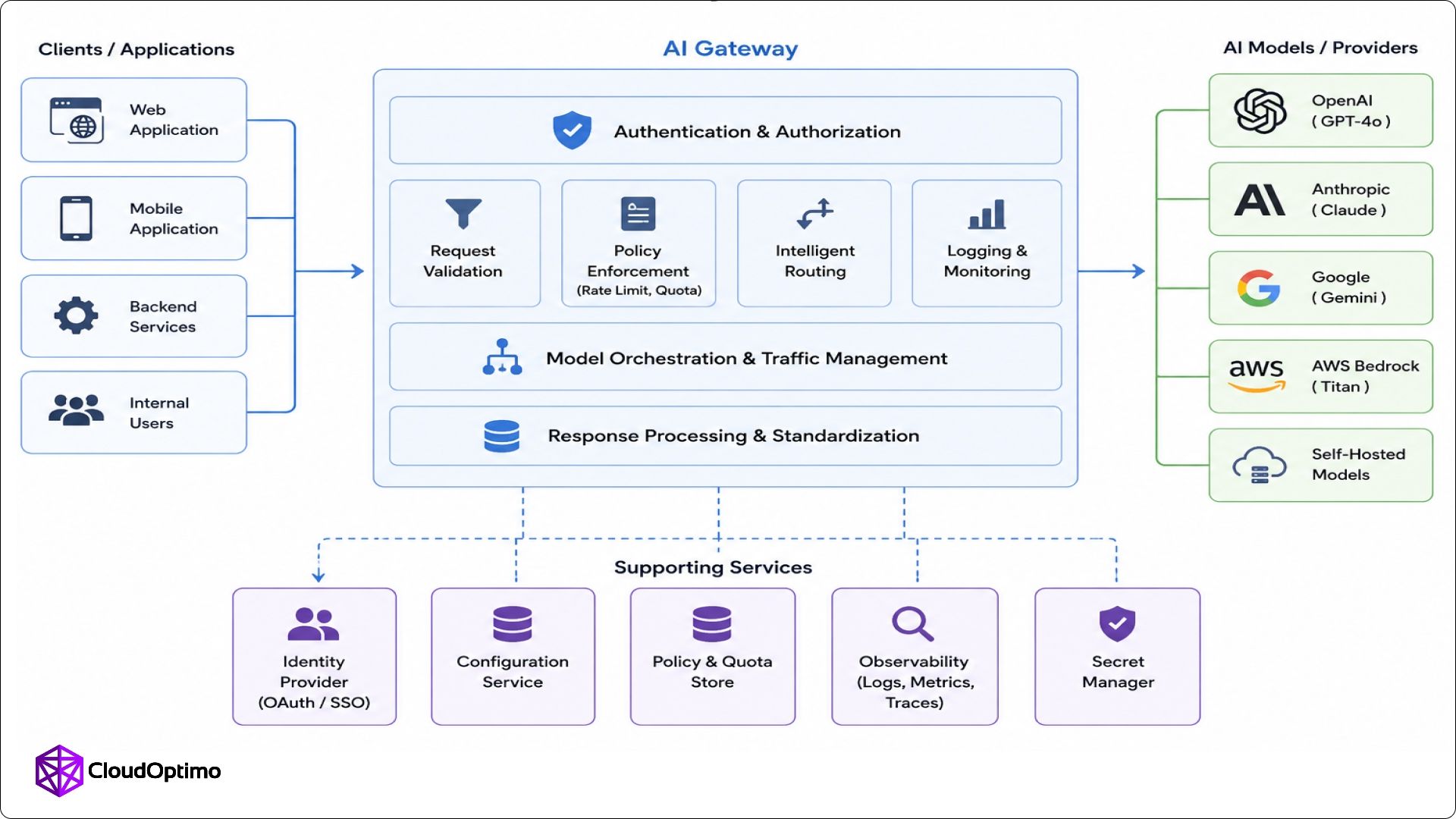
AI Gateway Architecture
A typical request follows a structured processing pipeline. After receiving a request, the gateway performs authentication and authorization, enforces policies such as rate limits, token budgets, or provider restrictions, and then evaluates routing rules based on factors like workload type, response latency, model capabilities, regional availability, and cost objectives. Once the most suitable model is selected, the gateway forwards the request and standardizes the response before returning it to the application.
By separating application logic from AI infrastructure, the gateway centralizes routing, governance, and policy enforcement while applications remain focused on business functionality.
The architecture also aligns well with cloud-native deployment models. AI Gateways can run behind load balancers, scale horizontally on Kubernetes or managed container platforms, and integrate with centralized identity, logging, and monitoring services. This provides operational visibility while allowing organizations to introduce new AI models or providers without changing application integrations.
This architectural foundation enables intelligent model routing, where requests are dynamically distributed according to capability, performance, and business policies.
5. Intelligent Model Routing
One of the primary responsibilities of an AI Gateway is selecting the most appropriate model for every request. In a multi-model environment, not all AI models are optimized for the same workloads. Some models perform better for complex reasoning, while others specialize in code generation or provide lower-cost inference for high-volume conversational requests.
Rather than relying on hardcoded application logic, an AI Gateway uses intelligent model routing to make routing decisions dynamically. This keeps applications independent of specific AI providers while allowing platform teams to update routing policies without modifying application code.
Several factors influence model selection. The gateway evaluates request type, prompt complexity, organizational policies, and workload requirements before forwarding requests to the most suitable model. For example, a simple summarization request may be routed to a lightweight model, while a complex analytical task can be directed to a larger reasoning model capable of producing more detailed responses.
Modern AI Gateways evaluate request context, latency objectives, model capabilities, and regional availability before selecting the most appropriate model, allowing routing decisions to adapt dynamically as workloads change. This helps maintain consistent performance while simplifying infrastructure management for distributed AI applications.
As organizations adopt models from multiple providers, intelligent routing becomes increasingly valuable. It enables engineering teams to balance performance, reliability, and operational efficiency through a unified routing layer while maintaining a consistent interface for client applications.
6. Multi-Model Orchestration
Model routing determines which model receives a request, while multi-model orchestration defines how multiple models collaborate to complete a workflow. Many enterprise AI applications require more than a single inference because different stages of a workflow often demand specialized capabilities.
For example, an enterprise knowledge assistant may retrieve relevant documents using one model, analyze the content with another, and generate a final summary using a third. Instead of relying on a single model for every task, orchestration distributes responsibilities across specialized models.
Similar orchestration patterns are also used in multi-agent AI systems, where specialized agents coordinate different models and tools to complete complex workflows. Our article on Google Vertex AI for Multi-Agent Systems: Architecture and Scaling explains how these orchestration patterns are implemented using managed cloud infrastructure and agent-based execution models.
AI Gateways coordinate these interactions by managing execution order and data flow between models. In sequential orchestration, one model processes the output of another, making it suitable for workflows where each stage depends on the previous result.
In parallel orchestration, multiple models execute independent tasks simultaneously, and the gateway combines their outputs into a unified response. This improves efficiency for workloads where tasks can be processed concurrently.
AI Gateways also support fallback execution. If a preferred model becomes unavailable or fails to meet routing policies, requests can be redirected automatically to an alternative model, improving service continuity without changing application logic.
As organizations adopt specialized AI models, multi-model orchestration becomes essential for building scalable workflows. By centralizing workflow coordination within the AI Gateway, engineering teams simplify application development while improving flexibility and long-term maintainability.
7. Rate Limiting and Token Governance
As AI usage increases across an organization, controlling resource consumption becomes just as important as delivering accurate responses. Every inference request consumes API capacity, tokens, and compute resources. Without centralized governance, multiple applications may compete for the same resources, leading to inconsistent performance and unnecessary operational costs.
An AI Gateway addresses this by introducing rate limiting and token governance before requests reach the underlying models. Rate limiting controls how frequently applications or users can submit requests within a specified time period, helping maintain stable system performance during periods of high demand.
Token governance focuses on managing how tokens are consumed across different workloads. Since many commercial AI services price requests according to token usage, controlling prompt size and response limits helps organizations maintain predictable operational costs while ensuring resources remain available for higher-priority workloads.
Instead of allowing every request to consume unlimited resources, the gateway can enforce organization-wide policies that define maximum token budgets, request priorities, and application quotas. These policies are applied consistently regardless of which model provider ultimately processes the request.
| Governance Area | Objective |
| Rate Limiting | Control request frequency |
| Token Governance | Manage token consumption |
| Request Prioritization | Allocate resources by workload priority |
| Quota Enforcement | Prevent excessive API usage |
Centralized governance allows organizations to update usage policies consistently across all AI services.
8. Cost-Aware Inference Routing
As organizations expand AI adoption, infrastructure cost becomes an important architectural consideration. Different AI models vary significantly in inference pricing, response speed, and computational requirements. Running every request on the largest available model often increases operational expenses without providing proportional value.
Cost-aware inference routing enables AI Gateways to select models based not only on capability but also on cost efficiency. Instead of applying a single routing strategy, the gateway evaluates workload characteristics alongside predefined budget policies before forwarding each request.
Routine operations such as text classification, summarization, or metadata extraction can often be handled by smaller models with lower inference costs. More advanced reasoning tasks or complex analytical workflows can then be routed to higher-capability models only when their additional reasoning power is required. This allows organizations to align infrastructure spending with business requirements while maintaining application quality.
Cost-aware routing also becomes valuable in multi-provider environments. If multiple providers offer comparable model capabilities, the gateway can select the service that best satisfies organizational priorities, whether those priorities focus on inference pricing, regional availability, response latency, or contractual commitments.
Because every request passes through the gateway, organizations gain centralized visibility into model usage, token consumption, and operational costs. These insights support continuous optimization while balancing performance and budget.
9. Scalability and High Availability
As AI adoption grows across applications and business units, an AI Gateway must scale efficiently while maintaining consistent performance and availability. Since every inference request passes through the gateway, it becomes a critical component of the overall AI infrastructure.
Cloud-native deployment enables AI Gateways to scale horizontally by running multiple gateway instances behind a load balancer. As request volumes increase, additional instances can be provisioned automatically to maintain throughput without affecting application behavior. Deploying these instances across multiple availability zones or cloud regions also improves high availability by eliminating single points of failure.
Resilience extends beyond the gateway itself. In multi-model environments, if a preferred AI provider experiences higher latency or a temporary service interruption, the gateway can route requests to an alternative model that satisfies the same routing policies. This helps maintain service continuity while reducing operational risk.
Scalability should also include supporting services such as authentication, policy evaluation, routing, and observability. Scaling these components alongside inference traffic creates a more resilient and efficient cloud-native architecture capable of supporting production AI workloads.
10. Observability and Security
Managing AI traffic across multiple providers requires complete visibility into request execution. Because every request passes through the AI Gateway, it provides a single point for monitoring operational metrics, service health, and policy enforcement.
Observability begins with end-to-end request tracing. Rather than monitoring individual models separately, platform teams can follow the complete request lifecycle—from client authentication and model selection to inference execution and response delivery. This simplifies troubleshooting and provides better insight into system behavior.
Key metrics such as request latency, routing accuracy, token consumption, provider response times, model availability, and gateway throughput help teams measure performance and identify optimization opportunities before they affect production workloads.
Security is equally important because the gateway controls access to AI services. Authentication verifies client identity, while authorization ensures users and applications can access only approved models and AI capabilities. Audit logs further strengthen governance by recording routing decisions, authentication events, model usage, and policy enforcement activities for compliance and operational reviews.
Together, observability and security enable AI Gateways to deliver reliable, scalable, and well-governed AI services. As organizations adopt multi-model cloud applications, this visibility and control become essential for maintaining consistent performance, operational governance, and secure AI service delivery.
11. Frequently Asked Questions (FAQ)
1. Why does an AI Gateway send similar requests to different AI models?
AI Gateways evaluate routing policies before every request. Factors such as prompt complexity, latency requirements, model availability, organizational policies, and operational cost influence which model is selected. This dynamic routing improves efficiency while ensuring applications receive the most appropriate AI service for each workload.
2. How can I reduce AI inference costs without affecting response quality?
Many organizations use cost-aware inference routing to match workloads with the most suitable models. Smaller models can handle routine tasks such as summarization or classification, while larger reasoning models are reserved for more complex requests. This strategy reduces operational costs while maintaining application quality.
3. What happens if my preferred AI model becomes unavailable?
A well-designed AI Gateway supports fallback routing policies. If the preferred model experiences service degradation or becomes temporarily unavailable, the gateway automatically redirects requests to an alternative model that satisfies predefined routing rules. This improves application availability without requiring client-side changes.
4. How do AI Gateways manage API rate limits across multiple providers?
Instead of allowing every application to interact directly with AI providers, the gateway applies centralized rate-limiting and token-governance policies before forwarding requests. This prevents excessive API consumption, maintains predictable performance, and simplifies operational management across multiple cloud AI services.

